

Eating the Engram
A brief history of memory — in cells, worms, and beyond the brain.

Please assume, for the sake of argument, that there is in our souls a block of wax.
So begins Plato’s treatise on memory, the “mother of Muses.” To remember, Plato said, we hold our thoughts to our internal wax, imprinting them, as with a seal ring. Over time, the wax softens, our memories fade; what we don’t imprint, we forget.
This is an archaic model for memory, but not an entirely inaccurate one. A wax imprint is a form of memory, in a literal sense — just as a book is, an etching on a wall, or a footprint left behind on some archaic plain. “Any physical medium that allows information to persist over time carries information about the past,” says Sam Gershman, a cognitive scientist at Harvard. “That perspective helps us take a step back away from some of the brain-centric ideas about what memory is.”
I spoke to Gershman recently for a piece I was writing for Quanta about brainless forms of memory. His lab is currently studying the ciliate Stentor coeruleus, a primitive unicellular organism that nonetheless appears capable of remembering its past. Although microscopic pond creatures might seem beyond the ken of cognitive science, Stentor is remarkably like a neuron, with similar excitable membranes and action potentials. If scientists like Gershman can uncover how ciliates remember, it may help us to trace what ancient forms of memory still linger in our own cells.
Gershman’s work so new that it’s still unpublished, but his questions are old ones. What is memory? Where does it live? We still don’t have good answers. Plato had his wax impressions, to which the German zoologist Richard Semon later gave the name engrams. Discovering the nature and location of engrams in the brain was, Semon presumed, a “hopeless undertaking” for the science of his day. It stymies us still.
In the 1960s, an eccentric behavioral psychologist named James V. McConnell took up Semon’s gambit with a series of studies on planarian flatworms. Flatworms are a particularly useful organism for studying memory: they’re one of the simplest creatures to possess a brain and a nervous system with the same bilateral symmetry as ours. They also have an uncanny ability to regenerate. If a planarian worm is chopped in half, both halves will regrow into a new worm — tail from head, and head from tail.
McConnell devised a series of experiments to test associative learning in planarians, repeatedly shocking them while exposing them to a bright light until they associated the light with the shock — think Pavlov’s worm. Once confident that the worms remembered this training, McConnell beheaded them all. As he expected, the new worms that grew from the severed heads remembered the shocks and reacted in kind.
What McConnell didn’t expect was that the worms that grew back from the headless tails retained their training, too. Their brains had been entirely lopped off, but they still anticipated the dreaded shock that accompanied McConnell’s bright light. This meant that whatever form the worms’ memories took, they weren’t the exclusive purview of their brains. They lurked somewhere — or maybe everywhere — else.
McConnell took this work a step further by grinding up his trained worms and feeding them to their naive brethren; the cannibal worms picked up the light response right away, as though they were remembering, rather than learning, what to do. Could the worms have eaten the engram? “In the jargon of computer engineering, information is always ‘fed’ into a computer,” Arthur Koestler later wrote, in a survey of McConnell’s work. “Here the metaphor became flesh.”
Media coverage in Time and Esquire extrapolated McConnell’s findings into a dubious future of piano lesson pills and cannibal students. But although edible memories made him one of the most famous public scientists of the 1960s, the scientific community viewed McConnell’s experimental work with skepticism. It didn’t help that he published all his research in a satirical journal called The Worm Runner’s Digest.
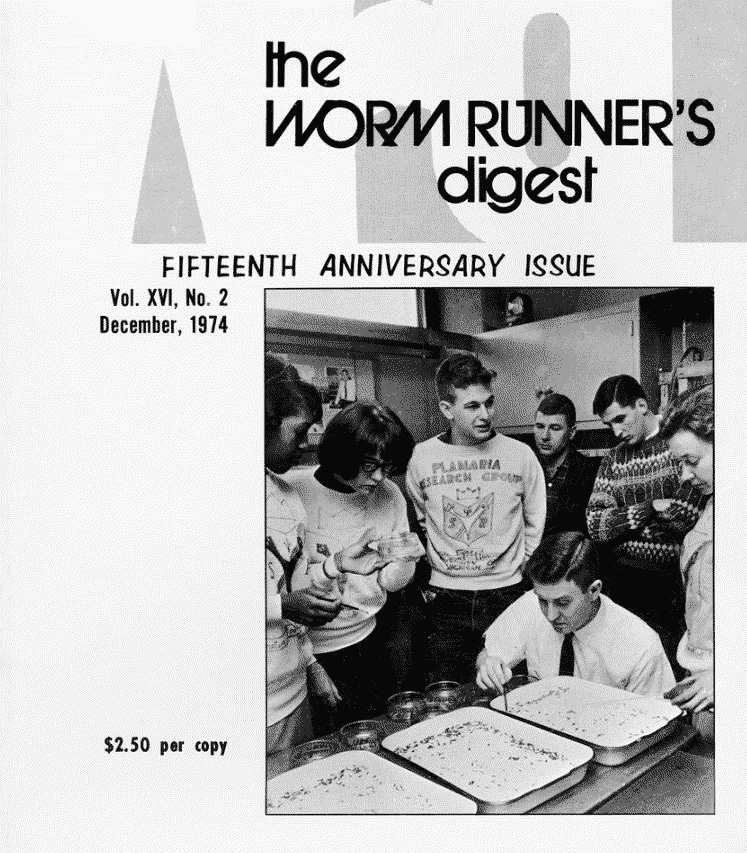
“There’s a wide swath of people in neuroscience who consider [McConnell’s] memory transfers a traumatic memory that discredited the field,” explains Gershman.
But this stigma is lifting. In 2018, UCLA neuroscientist David Glanzman performed a similar, albeit less macabre, experiment on the sea slug Aplysia california. After training the slugs to respond to a shock to their tails, Glanzman was able to transfer the sensitization from one slug to another via a direct injection of genetic material. This suggested that memories are stored in RNA, a contention McConnell shared, and that they aren’t choosy — Glanzman only had to inject into the neighborhood of the nervous system for a memory to transfer to a new slug.
Michael Levin, who studies the emergence of intelligence at Tufts University, has interpreted this slug-agnostic memory as evidence of biology’s robust “remapping” capacity. In Levin’s view, life’s most interesting trick isn’t memories themselves — which, like any compressed information, in living and computational systems alike, are bound to be quite lossy — but the slug’s capacity to reinterpret them in a new context. In a recent paper in the journal Entropy, he wrote that the “engrams” in Glanzman’s experiment “seem less like encoded memories and more like a kind of prompt,” containing just enough information for the slug to deploy to new ends.
Memories, Levin argues, aren’t about fidelity; they’re about salience. He gives the example of a caterpillar becoming a butterfly. In the cocoon, the caterpillar’s memories persist as its brain turns to goo; a caterpillar trained to avoid a certain smell, for example, will retain the aversion on the other side of metamorphosis. But since the caterpillar’s life experience — memories of crawling on delicious leaves — aren’t relevant to the butterfly, who moves through 3D space in search of nectar, the butterfly must generalize its old memories, remapping them, literally, on the fly.
“Leaves,” no longer relevant to the butterfly, become generalized as “food,” Levin explains. This biological aptitude for “mnemonic improvisation,” for bringing the lessons of past experience to bear in a constantly-shifting world, is, he argues, “a ratchet that gave rise to intelligence.” Evolutionary survival, after all, is a matter of adapting to change. And while memory drives this adaptation, it’s not always precisely relevant. Think of the butterfly: to survive, it reinterprets its past for a completely different future. As always with biology, a little creativity goes a long way.

If you’re interested in these kinds of questions, I just published that piece for Quanta. It’s about the cohort of cognitive scientists and neuroscientists, including Gershman, rewriting everything we know about memory. For the better part of a century, we’ve assumed that memory is an intercellular phenomenon: that it’s the consequence of collections of neurons in our brains wiring together. But new research on individual human cells and tiny unicellular creatures is revealing that memory transcends these connections — and that even the smallest solitary cell remembers its past experiences.
It was wonderful to get to talk to several leading thinkers in this emerging field. Even strictly defined, memory is a philosophical subject, and the scientists who are drawn to it seem to be deeply invested both in the history of these ideas and what their findings imply for our understanding of agency and cognition. As the microbiologist Dennis Bray writes, although an individual cell may be “a robot made of biological materials,” it’s also “undeniably the ‘stuff’ of which consciousness is made.”
A few strong, completely unrelated recommendations for your week:
Earth.fm, a library of immersive natural soundscapes from all over the world. It’s got it all: the sound of melting snow in the Baltics. Iberian midwife toads tooting at dusk. Costa Rican jungle rain. And the non-profit that runs the project cites Zen Master Thich Nhat Hanh’s Earth Holder Community as inspiration. This playlist is a good starter; there’s also a mobile app. Great for writing.
Charles Aznavour’s early ‘70s queer elegy, “What Makes a Man a Man.” I first heard this song as the soundtrack to The Other Side, a slideshow of Nan Goldin’s photographs. I grew up on devastating French music, so I have a particular affection for this kind of narrative torch song, but I can’t get over how efficient and vivid Aznavour’s writing is here — and how ahead of its time.
Charles Portis’ 1985 novel Masters of Atlantis. An arch satire of midcentury American esoteric movements, it follows a group of “Gnomonists” ostensibly preserving the knowledge of the lost city of Atlantis as their movement rises and falls. Full of proto-New Age neologisms, ludicrous hats, and failed experiments in alchemical metallurgy, it’s extremely funny without ever tipping into farce.
Finally, an invitation to any readers in Los Angeles! On August 7th at the Bob Baker Marionette Theater, we’re celebrating the launch of the video game I wrote, Blippo+.

The game, which is entirely live-action, stars over 100 performers and represents the culmination of an enormous amount of creative work from a dedicated group of artists over nearly five years. At the party we’ll have an exhibition of production props and costumes, hands-on demos of the game in multiple formats, a puppet show, and lots of fun surprises. No cells, worms, or ciliates will be harmed. Come see!
xo
Claire
Almost sent this to you, before I realised you wrote it! What? Worms!
I am in awe that I had not heard any of this till now. I kind of knew in a gutteral sense that something like this must be true, but this is just eye opening information! Thank you for this