

Report from Goleta
An account of three days haunting the halls of the Institute for Theoretical Physics.


The Kavli Institute of Theoretical Physics sits on a wedge of prime real estate between the Pacific ocean and a quarter-acre of restored wetlands in Goleta, on the campus of the University of California Santa Barbara. It’s an idyllic place for a life of the mind. The air smells of jasmine and brine; just beyond the sandstone bluffs, local teenagers slap each other with ropes of beached kelp and seabirds hang low in the sky.
At each entrance to KITP are signs warning undergraduates away. The signs are new. Recently, a student TikTok about the building’s vibey architecture went semi-viral, exposing its apricot-colored seminar rooms and shiplike circular windows. As a result, there has been an epidemic of selfies, much to the exasperation of the chalk-dusted figures who ordinarily roam its halls. The inner sanctum of KITP is off-limits to everyone but a rotating group of these invited scientists, whose credentials are signaled by the matching brown coffee mugs they’re assigned on arrival.
Every morning, the scientists take turns giving technical morning lectures and vociferously interrupting one another. To an outside observer, the social dynamics revealed by this display are inscrutable. Barely two slides into a presentation on gene regulatory networks, the volley of interjections has already begun:
“In principle, couldn’t you…?” a wild-haired physicist in the back row begins.
“But what, exactly, is this data set?” blurts a computer scientist.
Things continue in this mode, the questions coming faster than I can jot them down. An equation onscreen sends the room into a brief orthographic hysteria.
“What’s D?”
“What’s T?”
“What’s S(y)?”
“Sorry, what was Y?”
“B is a random vector of no importance.”
“And C is a random walk?”
“Does that number scale with the square root of D?”
“No, this is W, not X.”
“So S(y) is zero?”
“And what is K?”
“Can I move on?”
I’m here for an interdisciplinary workshop on the subject of “Biological Learning Without a Brain.” It has drawn neuroscientists, biophysicists, computer scientists, and biologists from all over the world. During these seminars, it’s easy to tell which is which. Any time a specific field is invoked, its representatives lurch forward in their seats, signaling with their bodies not only their interest in the matter at hand, but their keenness to contest its finer points. The more acute the angle of this lean, the more imminent the torrent of commentary. There’s nothing hostile in this, as far as I can tell. The scientists aren’t jockeying for prominence; they’re motivated by an earnest desire for clarity, for closeness to an elusive, unambiguous truth. I have sat in on many analogous seminars in the humanities, and in countless art-school critiques, and I’ve never witnessed such adversarial conviviality. At all times, the speaker is under trial by fire, but it never burns. Having explained it all, they emerge unscathed.
“Oh, I’m used to all that,” says Sam Gershman, the Harvard neuroscientist who invited me out to Goleta. Gershman is freckled, with a runner’s build and a perpetually squinting expression. After the morning seminar, over burritos in Isla Vista, he tells me about a theory that cancer is what happens when cells revoke multicellularity and revert to an archaic state, recapitulating their origins as solitary cells—with the commensurate drive to divide and multiply. We chew our burritos. Maybe our cells yearn to be free of us, I think, most unscientifically. Maybe they’re exhausted by the constant negotiations in time and space it takes to maintain the form of an eye, a limb, a mind. Lord knows I’m tired too.
Dr. Gershman studies, among other things, the biochemical basis of memory. While most neuroscientists are convinced that memories are stored in the connections between cells—in the networks of synapses and neurons upon which AI systems are modeled—Gershman, like many of the scholars here, has a hunch that some aspect of memory is chemical, stored in the cell itself. After all, our cells trace their evolutionary origins to independent, free-swimming ancestors, and those distinctly brainless creatures must have had the capacity to adapt to their experiences and remember the relevant features of their world, or else they never would have survived.
Biology is the product of adaptation to a long series of coincidences and constraints. Evolution has produced countless solutions to the problem of survival over eons of trial and error, and those solutions—eyes to see danger, minds to anticipate it, potential cellular machinery to store and pass on what we’ve learned—are not always the most straightforward or logical. They’re certainly not the kind of solutions that engineers would come up with. What we’re left with is merely what has worked, what successfully carried those unicellular ancestors all the way to personhood.
But biology’s possibility space is greater than the configurations in which it currently exists. This has been a theme of my time here. A test tube full of DNA molecules can store data and perform basic computational tasks. The internal networks of cells, modeled in the computer, become fascinating mathematical abstractions to tweak and fiddle with. The vascular networks of slime molds inspire new algorithms. And so on.
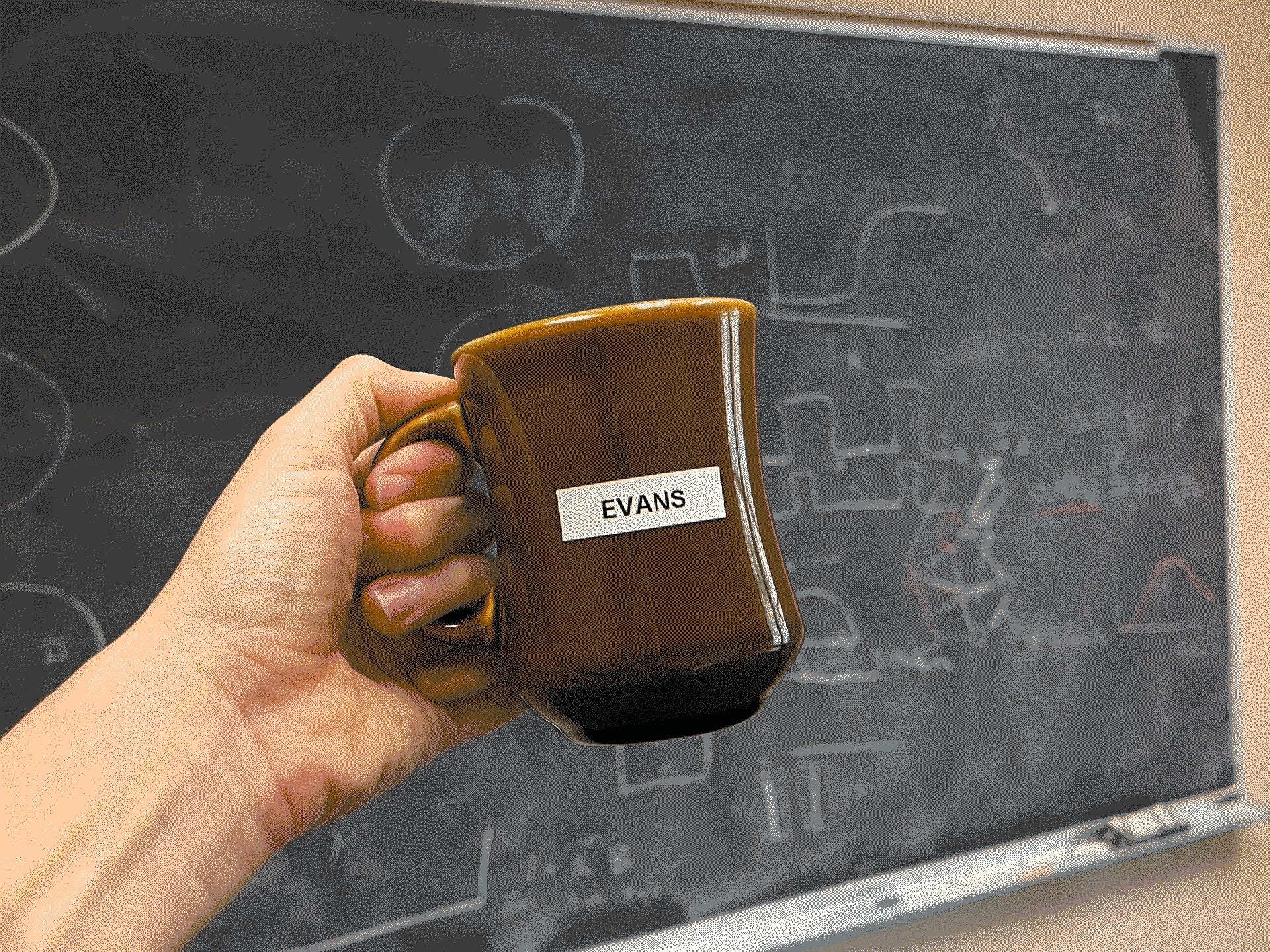
Back at KITP, I’ve been assigned an office on the second floor, which I’m sharing with Michael Elowitz, from CalTech. Elowitz is a pioneering synthetic biologist; he devotes his life to engineering molecules that can identify and kill cancer cells. When I ask him about this notion of cancer cells as individualists disavowing the collective body, he gives a jovial harumph. “Well, that’s a bit anthropomorphic,” he says.
After all my years spent talking with scientists, I’m still never quite sure when it’s appropriate to speak in metaphor. As Philip Ball observes, there are plenty of metaphors in science. Molecules recruit one another, for example. Cells signal to one another. The so-called central dogma of molecular biology is that DNA transcribes genetic instructions onto messenger RNA, which then translate them into proteins. These are accepted analogies, so absorbed into the language of biology as to be effectively invisible. Others, more emergent, remain hotly contentious.
In the KITP’s Tower Room, a hexagonal crow’s nest overlooking the ocean, group gathers to discuss this matter—specifically, if “learning” is an appropriate metaphor to use when talking about cells, plants, or the physical properties of living matter. Biology is counterintuitive; the molecular mechanisms driving the behaviors in question are still unclear. In the face of such uncertainty, language might constrain knowledge as much as it summarizes it. What might we miss by approaching the unknown with a narrative framework already in place? On the other hand, without metaphors, how are we supposed to grasp complexity? Is it anthropocentric to port human concepts to the nonhuman world? Is it anthropocentric not to?
Naama Brenner, a theoretical biophysicist and one of the organizers of the workshop, kicks things off. “We all like to think in equations,” she offers. “But our equations have words behind them.” At this, a physicist pushes back—aren’t equations just boring stories? The computer scientists bristle. Boring to who? A plant biologist suggests everyone watch a time-lapse video of a climbing vine. “It’s clear there is something complicated going on,” she says. Lots of things look like learning, but are they? A neuroscientist suggests a distinction between learning and inference, but all anyone can agree on is that neuroscientists are intransigent about language. The machine learning researchers are less so, for obvious reasons. “We don’t have a strong bias against this term,” one shrugs. As the resident humanist, I try and make a case for ambiguity. Maybe it’s a good thing language isn’t fixed, I suggest—like life, it evolves. Biophysicist Arvind Murugan dutifully writes everyone’s suggestions on the blackboard; by the end of the discussion, his hands are white up to the wrists with chalk dust. The answers, as ever, remain elusive.
In other news, I hopped on the Quanta Podcast to talk with editor-in-chief Samir Patel about the weird science of memory transfers. Patel called my Quanta story about this “just the right level of unhinged,” so I guess I’m doing something right. 🪱
Speaking of Quanta, I loved this piece from Philip Ball (a gifted science writer, who I mentioned above) on the ways in which biologists are wrestling with another contentious term—“agency”—to describe the purposefulness of living things.
And finally, an upcoming event I’d like to put on your radar:

60 years ago, MIT computer scientist Joseph Weizenbaum created a simple chatbot named ELIZA. Programmed to respond to queries in the style of a Rogerian psychotherapist, its open-ended dialogue proved uncannily absorbing—to the point that Weizenbaum, alarmed by how easily people confided in a computer program, became an early and impassioned critic of Artificial Intelligence.
To quote Weizenbaum himself, from the 1978 documentary The Mind Machines:
“Even the most ordinary linguistic intercourse among people involves shared experiences. And the fundamental difficulty with computer understanding of language is that there are human experiences, uniquely human experiences, which the computer by its very nature—in virtue of its structure, in virtue of the difference between its structure and the biological structure and needs of human beings—can simply not share. Communication involves sharing.”
Next Sunday, July 19th, I’m hosting an event here in Los Angeles to celebrate the release of Inventing Eliza (MIT Press), the first comprehensive critical analysis of Weizenbaum’s system. Three of the book’s co-authors—pioneering new media artist Peggy Weil, electronic literature scholar Mark Marino, and software developer Arthur I. Schwartz—will join me for a discussion about language, Weizenbaum’s legacy, and our modern parasocial attachments to chatbots. We’ll learn about how the team rediscovered and reconstructed Weizenbaum’s lost source code, and talk about how to read ELIZA and its many inheritors through the lens of critical code studies.
Onsite ELIZA therapy sessions will be available, naturally.
✨RSVP here!✨
xo
Claire